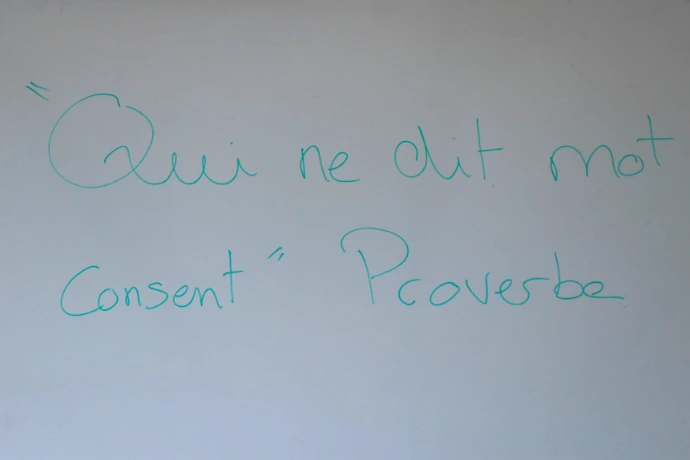
Knowledge and independent thinking – the cornerstones of democracy – are mainly acquired at school and through reading. This, at least, is the conviction that led to the co-creation of a course entitled ‘The rise of totalitarianism as seen through literature’ by a French teacher and the school librarian at the Trois-Sapins secondary school in Echallens (CH). Developing critical thinking, raising awareness of civic responsibility and discovering the societal role of libraries were all on the curriculum for the pupils who benefited from this interdisciplinary teaching.
At the Trois-Sapins secondary school in Echallens (CH), a French teacher and the school librarian pooled their expertise to create a course with an innovative format and content rooted in current world events. By studying the books Brown Morning by Franck Pavloff, Address Unknown by Katherine Kressmann Taylor, and Animal Farm by Georges Orwell, the pupils of a final-year class learnt about democracy and, above all, about what can threaten it. A suggested didactical sequence, including resources drawn from this teaching, will soon be posted on the Voie Livres website (www.voielivres.ch) for teachers wishing to discover and adapt it.
Concepts that transcend subject boundaries
Entitled ‘The rise of totalitarianism as seen through literature’, the course took place for the first time in the autumn semester of 2025. Various interactive activities, such as two-voice reading and role-play debates, were carried out alternately in the classroom and the school library. The teaching sequence thus aimed to develop not only skills specific to French, like argumentation, but also to meet interdisciplinary objectives. The study of political systems, for instance, was covered transversally in history, citizenship and this course, and the class even addressed the subject in their German lessons, watching Dennis Gansel’s film The Wave.
‘As soon as we enter the realm of ideas, there is an opening up to a variety of fields and skills,’ remarks Marie-Jo De Rabano, the French teacher behind the project. ‘I therefore think it is invaluable for colleagues to be able to complement one another,’ she continues. This is indeed what motivated her collaboration with Nadia Brandt, the school librarian, to co-create this interprofessional teaching. ‘Part of my job consists in complementing the work done at school by providing a wide range of information,’ she explains. ‘And this isn’t limited to French: teachers of every field can find verified information resources in the library.’
Literature to sharpen the mind
The primary aim of the teaching project was to ‘provide pupils with tools to develop their critical thinking,’ as Marie-Jo De Rabano explains. ‘One of the shared missions of schools and libraries is to help young people understand the world and think for themselves,’ Nadia Brandt adds. And what better way than reading – the link between the two professions – to enlighten minds with a multitude of perspectives? ‘Books allow one to travel, to identify with characters, but also to reflect on situations experienced here or elsewhere,’ some pupils say at the end of the course.
'Democracy cannot be taken for granted.'
‘Literature is a reflection of society,’ agrees Marie-Jo De Rabano, whose aim was also to make her pupils aware that democracy cannot be taken for granted. At a time when we are witnessing, across the world, an upsurge in liberty deprivations that is reminiscent of certain historical events from the early 20th century, the teacher believes it is more important than ever to address these issues in school. ‘When we first discussed the novel Brown Morning,’ she recounts, ‘I was struck by the pupils’ fatalism: in their view, the characters could do nothing in the face of creeping totalitarianism. Fortunately, their analysis was quite different by the end of the teaching; I am proud that the course helped them understand the importance of reacting as soon as our rights are threatened.’
Libraries: tools for democracy
Civic education is a responsibility that libraries, amongst other institutions, share with schools. ‘Libraries are at the heart of cities and current affairs,’ says Marina Jovanovic, cultural mediator at Bibliomedia Lausanne. ‘Historically,’ she continues, ‘their role has been to democratise access to knowledge and words, which enable people to define themselves, to name things, to understand and to exist. The political implication of this is significant.’ Thus, the choice of which books are included or not in the library stock is anything but trivial, and this poses a constant challenge for librarians, who must balance the quality and diversity of content against a limited budget and, often, limited staff.
'Words enable people to define themselves, to name things, to understand and to exist.'
‘Making a choice means taking a stand, and therefore conveying a message,’ Marina Jovanovic emphasises. ‘For example, it is important to include works by authors from minority backgrounds, who are under-represented in today’s publishing world.’ Whilst libraries have a duty to offer a plurality of voices within a given theme, they must do so while adhering to their code of ethics. ‘We cannot simply accept every book that is offered to us on the pretext of representativeness,’ the cultural mediator illustrates, ‘because if a publication promotes dangerous ideas or ones that go against the values of social cohesion that lie at the heart of our mission, it has no place in a library.’
Beyond their literary collection, libraries also play a vital role as ‘third places’. ‘They are places where you can go and stay as long as you like, and where you have access to information and entertainment, all of this for free,’ Marina Jovanovic explains. ‘Contrary to popular belief,’ she adds, ‘they are very lively places where we can chat, have a coffee, cocreate…’ The final-year pupils at the Trois-Sapins secondary school were able to grasp this social and societal role played by libraries thanks to the course they undertook. ‘A library is a democratic tool,’ some point out during the closing discussion, ‘because there are all sorts of stories and opinions available for free.’
À propos de Bibliomedia
Bibliomedia est une fondation nationale mandatée par la Confédération dont la fonction principale est de soutenir les bibliothèques, les écoles et d'autres institutions suisses en leur prêtant des collections de livres. Fondée en 1920, elle est présente dans chaque région linguistique, avec un site à Lausanne, un à Soleure et un à Biasca.

Depuis 2015, Bibliomedia Lausanne dispose d'un service de médiation culturelle, le Laboratoire des bibliothèques, dont la mission est d'outiller les bibliothécaires, les médiateur·trice·s culturel·le·s et d'autres professionnel·le·s pour un accueil plus inclusif des publics. Il héberge notamment des formations continues ainsi qu'un groupe de discussion trimestriel permettant aux médiateur·trice·s culturel·le·s de s'enrichir mutuellement de leur expérience.
À propos de Bibliomedia
Bibliomedia est une fondation nationale mandatée par la Confédération dont la fonction principale est de soutenir les bibliothèques, les écoles et d'autres institutions suisses en leur prêtant des collections de livres. Fondée en 1920, elle est présente dans chaque région linguistique, avec un site à Lausanne, un à Soleure et un à Biasca.
Depuis 2015, Bibliomedia Lausanne dispose d'un service de médiation culturelle, le Laboratoire des bibliothèques, dont la mission est d'outiller les bibliothécaires, les médiateur·trice·s culturel·le·s et d'autres professionnel·le·s pour un accueil plus inclusif des publics. Il héberge notamment des formations continues ainsi qu'un groupe de discussion trimestriel permettant aux médiateur·trice·s culturel·le·s de s'enrichir mutuellement de leur expérience.
About Bibliomedia
Bibliomedia is a national foundation commissioned by the Swiss Confederation, whose main function is to support libraries, schools and other Swiss institutions by lending them collections of books. It was founded in 1920 and has a presence in each linguistic region, with one site in Lausanne, one in Solothurn, and one in Biasca.
Since 2015, Bibliomedia Lausanne has had a cultural mediation service, the Laboratoire des Bibliothèques, whose mission is to empower librarians, cultural mediators and other professionals to provide a more inclusive service to the public. In particular, it hosts continued professional development courses as well as a quarterly discussion group enabling cultural mediators to learn from one another’s experiences.
About Bibliomedia
Bibliomedia is a national foundation commissioned by the Swiss Confederation, whose main function is to support libraries, schools and other Swiss institutions by lending them collections of books. It was founded in 1920 and has a presence in each linguistic region, with one site in Lausanne, one in Solothurn, and one in Biasca.
Since 2015, Bibliomedia Lausanne has had a cultural mediation service, the Laboratoire des Bibliothèques, whose mission is to empower librarians, cultural mediators and other professionals to provide a more inclusive service to the public. In particular, it hosts continued professional development courses as well as a quarterly discussion group enabling cultural mediators to learn from one another’s experiences.
When the right to information is under attack
But this democratic function of libraries is directly threatened by censorship, a topic which, as part of the wider theme of totalitarianism, was explored in depth in one of the teaching modules. ‘Books and information are the first targets when people want to control thoughts,’ Nadia Brandt explains. ‘It is crucial that pupils, being tomorrow’s citizens, are made aware of this.’ To illustrate this reality in a striking way, she presented them with about fifteen books which are available in Swiss school libraries and yet part of the 23’000 or so titles currently censored in several American States, according to the database of the organisation PEN America.
‘Books and information are the first targets when people want to control thoughts.’
Among those were Maus by Art Spiegelman, The Diary of Anne Frank, but also Looking for Alaska by John Green, or Twilight by Stephenie Meyer. ‘Several pupils who had read those books were outraged to learn they were censored in the United States and disagreed with the official reasons given,’ tells Marie-Jo De Rabano. For, cloaked in a strong lexicon describing the works as ‘vulgar’ or ‘sexually explicit’, the grounds for censorship frequently stem from an intention to silence topics related to social justice, historical memory, or issues like mental health, gender identities, and teenager relationships – all subjects which it is, precisely, essential to hear about at this crucial stage of one’s life.
Standing together to defend intellectual freedom
Unfortunately, the censorship is not as remote a reality as it might seem: ‘Even though there is no list of banned books in Switzerland, censorship does exist, albeit in a more insidious form,’ observes Marina Jovanovic. It is, in fact, not uncommon for professionals to refrain from including certain types of books in their collections for fear of negative reactions from the public or parents of pupils. To open up a dialogue on this issue, the cultural mediation service of Bibliomedia Lausanne recently organised, in collaboration with Le Cinématographe, a screening of The Librarians, a documentary film by Kim A. Snyder about literary censorship in the USA.
'Resistance is possible when we organise together.'
‘The round-table discussion that followed was encouraging for the future,’ recounts Marina Jovanovic, ‘as it showed that resistance is possible when we organise together.’ The key, in her view, to effectively countering attacks on intellectual freedom? ‘Keep it small, united, and visible.’ In other words, acting on a small scale to conserve energy, pooling resources, and make one’s commitment visible. ‘For institutions, it is particularly important to set out their approach in writing,’ the cultural mediator adds, ‘in the form of a charter, for example, or of a documentary policy in the case of libraries.’
Having the words to resist
This shows once again just how meaningful words are in a society: while they can serve as tools for population control in a totalitarian state, they can, conversely, act as a bulwark against anti-democratic measures. ‘You can only defend your values, your rights and your opinions if you have the words to do so,’ remarks a pupil, recalling the Farm Animal characters’ inability to protest. ‘Censorship, disinformation, indoctrination… It is essential to name these mechanisms at school so that young people realise they exist and that it is possible to oppose them,’ Marie-Jo De Rabano concludes. ‘And even if it may seem a little early to talk about such topics, it is important to sow the seeds.’